
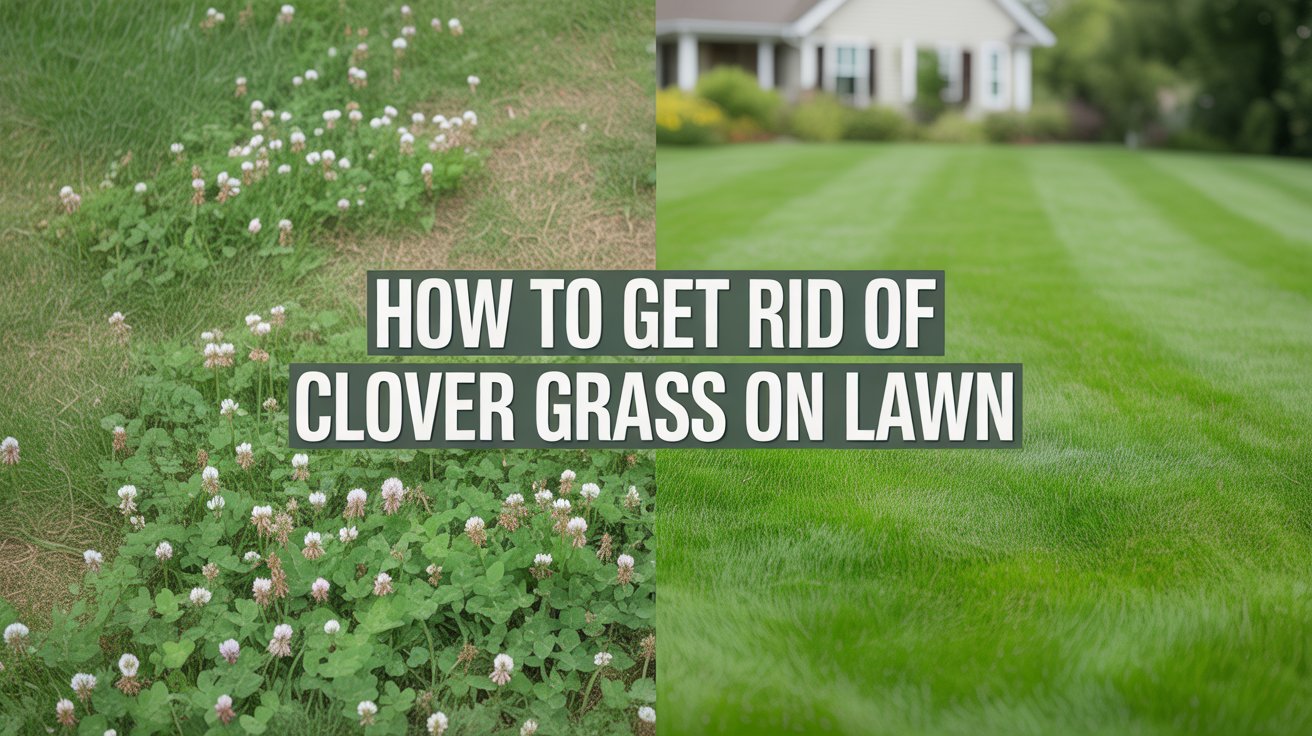
You step outside on a Saturday morning, coffee in hand, and there it is — that unmistakable carpet of three-leafed plants spreading across your lawn. Clover. Not a patch. A takeover.
If you’ve been searching for how to get rid of clover grass on your lawn, you’re not alone. It’s one of the most common lawn complaints among American homeowners, and the frustration is valid.
To get rid of clover grass on your lawn, pull small patches by hand, deprive them of sunlight, or apply a selective broadleaf herbicide containing 2,4-D or dicamba — which kills clover without harming your grass. For a long-term fix, fertilize with nitrogen, mow at 3–3.5 inches, and overseed bare spots so clover has nowhere to establish.
Here’s the good news: you can Get Rid of Clover Grass on Your Lawn . Whether you want to go chemical-free or pull out something stronger, this guide covers every practical approach — and more importantly, explains why clover keeps coming back so you can stop it for good.
Why Clover Grows in Your Lawn in the First Place
Before you attack clover, understand why it showed up. Clover doesn’t appear randomly — it fills gaps your grass left open, and often, it’s pointing at an underlying problem.
The most common reasons clover establishes itself in lawns include:
- Low nitrogen in the soil — clover is a legume that fixes its own nitrogen. Grass that’s nitrogen-starved gives way; clover thrives.
- Compacted or thin soil — grass struggles; clover doesn’t.
- Low soil pH — acidic soil tends to favor clover over turf grasses.
- Mowing too short — scalping the lawn weakens grass and gives clover a foothold.
- Inconsistent watering — stressed grass leaves openings.
Treat the conditions and your removal efforts will last. Skip this step and clover will return regardless of what you spray.
How to Get Rid of Clover in Your Lawn Naturally
If you have kids, pets, or just prefer to keep things chemical-free, natural removal is very achievable — it just takes consistency. Here are the methods that actually work.
1. Pull It Out by Hand (Small Infestations)
For light clover patches, hand-pulling works well — but you need to get the root. Clover has a taproot and spreads through stolons (horizontal stems). Pull at the base, loosen the soil if it’s compact, and remove as much of the root as possible.
After removing, fill the bare spot with grass seed and water it. An empty patch is an open invitation for clover — or something worse — to return.
2. Deprive It of Sunlight
Clover needs light to survive. Covering clover patches with black plastic sheeting, cardboard, or even a thick layer of mulch for a few weeks can smother it effectively.
This works best on patches in garden borders or lawn edges — not ideal for large open lawn areas, but useful for problem spots near beds.
3. Raise the Nitrogen Level in Your Soil
This is the single most effective long-term natural strategy. Clover loves nitrogen-poor soil. A well-fertilized lawn with adequate nitrogen allows turf grass to grow thick and dense, crowding clover out on its own.
Use a slow-release nitrogen fertilizer in spring and fall. Match the fertilizer to your grass type — cool-season grasses like Kentucky bluegrass have different needs than warm-season grasses like Bermuda.
4. Vinegar Spray (Use with Caution)
A solution of white vinegar, water, and a small amount of dish soap can suppress clover, but it’s non-selective — meaning it will also harm surrounding grass. Apply directly to clover only, avoid hot days when it can volatilize, and use it on isolated patches rather than widespread areas.
Vinegar-based sprays are better described as “growth suppressants” than true killers. Repeated applications are often needed, and regrowth is common.
Pro tip: If clover is everywhere on your lawn, the vinegar approach isn’t practical. It’s a spot-treatment tool, not a lawn-wide solution.
What Will Kill Clover But Not Grass? (Selective Herbicides Explained)
This is the question most homeowners eventually land on when natural methods aren’t keeping up. The short answer: yes, selective broadleaf herbicides can kill clover without damaging your lawn grass — but the product and timing matter.
How Selective Herbicides Work
Selective herbicides are designed to target broadleaf plants (like clover, dandelions, and chickweed) while leaving grasses unharmed. They work by disrupting plant growth processes that broadleaf plants rely on but grasses don’t.
The key active ingredients to look for are:
- 2,4-D — one of the most widely used broadleaf weed killers, effective on clover.
- MCPP (Mecoprop) — often combined with 2,4-D for broader weed control.
- Dicamba — particularly effective on white clover (Trifolium repens), which is the most common lawn variety.
- Clopyralid — another option that targets legumes like clover specifically.
Application Tips That Actually Matter
- Apply in spring or fall when clover is actively growing and temps are between 60–85°F.
- Don’t mow for 2–3 days before or after application — clover needs leaf surface to absorb the product.
- Apply on a calm, dry day. Wind causes drift; rain washes herbicide away.
- Read and follow label directions — mixing stronger doesn’t work faster; it can burn your lawn.
Best Herbicide to Kill Clover in Lawns
There’s no single “best” product — the right choice depends on your grass type, the scale of infestation, and whether you’re treating the whole lawn or spot-treating patches.
Here are the most trusted categories of products:
Three-Way Herbicide Blends
Products combining 2,4-D, MCPP, and dicamba are widely considered the gold standard for broadleaf weed control in established lawns. They’re available as liquid concentrates (mixed with water and applied via sprayer) or ready-to-use formulas. These are effective on white clover and most other common broadleaf weeds.
Post-Emergent Weed & Feed Products
Granular weed-and-feed products that contain selective herbicide are a convenient option if you also want to fertilize. They work best on actively growing weeds and should be applied to damp grass so granules adhere to leaves.
Organic-Certified Broadleaf Herbicides
For homeowners wanting to avoid synthetic chemistry, Iron HEDTA-based herbicides (like those marketed for organic lawn care) can suppress clover. They’re slower-acting and may need repeated applications, but they’re safe for pets and children once dry.
Important: Always confirm your grass type before applying any herbicide. Some products are not labeled for use on St. Augustine, centipedegrass, or fine fescues. Using the wrong product can damage or kill your turf.
White Clover vs. Other Clover Types: Does It Change the Approach?
White clover (Trifolium repens) is the most common type found in American lawns — low-growing, spreading, with round white flowers. It’s the clover most people are dealing with.
Red clover (Trifolium pratense) is taller and less common in home lawns — more often found in pastures. It responds to the same removal approaches but is somewhat more difficult to eradicate due to its deeper root system.
Oxalis (wood sorrel) is sometimes mistaken for clover. It has heart-shaped leaflets and is not a true clover — it may require different herbicide chemistry. If your “clover” has yellow flowers, it’s likely oxalis.
How to Stop Clover from Coming Back
Killing existing clover is half the battle. The other half is not giving it a reason to return.
Mow at the Right Height
Cutting grass too short is one of the biggest factors that allows weeds to gain ground. For most cool-season grasses, mow at 3 to 3.5 inches. For warm-season grasses, follow the specific recommendation for your turf type. Taller grass shades the soil, reducing germination opportunities for clover seeds.
Fertilize Consistently
Nitrogen-rich soil is your best defense. A consistent fertilization schedule — typically two to four times per year depending on your grass type and region — keeps turf growing vigorously enough to outcompete opportunistic weeds like clover.
Aerate and Overseed Bare Areas
Compacted soil weakens grass roots. Annual aeration — using a core aerator in fall for cool-season grasses — improves drainage and nutrient uptake. Overseeding thin or bare patches prevents clover from filling the void.
Test and Adjust Your Soil pH
Most turf grasses prefer a slightly acidic soil pH between 6.0 and 7.0. If your soil is more acidic than that (below 6.0), applying lime can raise the pH and create conditions less favorable for clover. A basic soil test from a local extension office or garden center costs very little and can be genuinely revealing.
Water Deeply, Not Frequently
Shallow, frequent watering promotes shallow root growth in grass — and gives clover a competitive advantage. Deep, infrequent watering (aiming for about 1 inch per week, including rainfall) encourages grass roots to grow deeper, making turf more resilient.
Common Questions About Clover Removal
Is clover actually bad for my lawn?
Not inherently — clover fixes nitrogen, attracts pollinators, and stays green even in drought. Some homeowners intentionally include it. But if you want a uniform, grass-only lawn, it becomes a weed by definition. It also spreads aggressively and can crowd out desirable turf if left unchecked.
Will clover go away on its own?
Unlikely. White clover is a perennial — it comes back year after year from the same root system and spreads through stolons and seed. Without intervention, it tends to expand rather than retreat.
How long does it take for herbicide to kill clover?
Most selective broadleaf herbicides show visible effects within 7 to 14 days. Full kill — meaning roots and all — can take 3 to 4 weeks. Patience is important; don’t re-apply too soon or you risk over-treating and damaging surrounding grass.
Is it safe to apply herbicide around pets and children?
Most synthetic herbicides carry a re-entry interval — a period after application during which people and animals should stay off the lawn. This varies by product but is typically 24 to 48 hours after the product has dried. Always read the product label for the specific guidance. If this is a concern, iron-based organic options are worth considering.
The Bottom Line
Getting rid of clover in your lawn isn’t complicated — but it does require understanding what’s actually driving its growth. If your lawn is thin, nitrogen-depleted, or poorly maintained, clover will keep returning no matter how many times you spray it.
The smartest approach combines direct removal — whether natural or chemical — with the cultural practices that give your grass a fighting chance. Fix the soil, mow at the right height, fertilize on schedule, and fill bare spots with grass seed. Do all of that, and clover won’t find much room to work with.
A healthy, dense lawn is the most durable weed control system there is.