
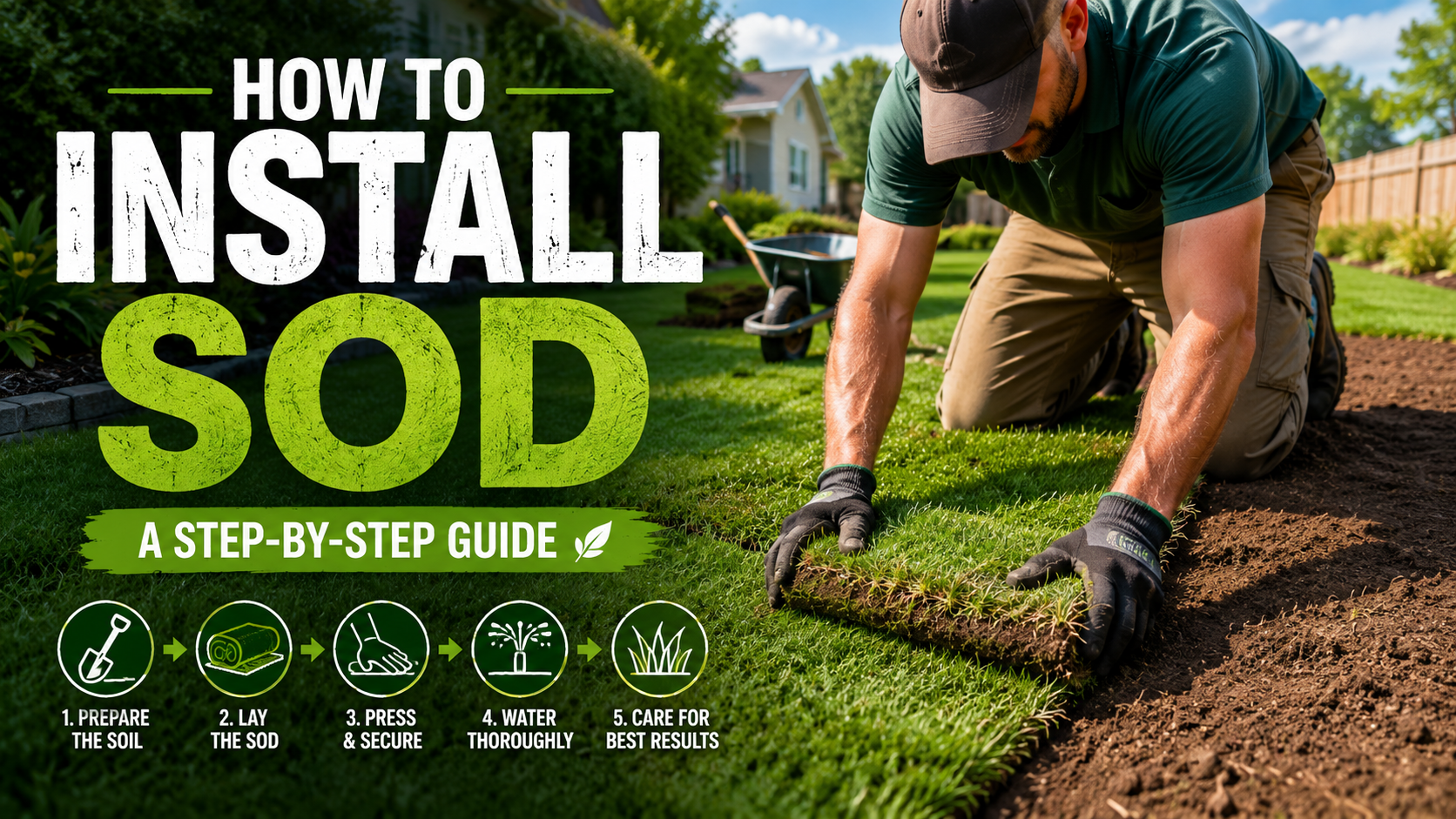
A bare, patchy, or weed-ridden yard is one of the most common frustrations homeowners face. Seeding a lawn from scratch takes months. Sod gives you an instant, lush, green lawn — but only if you install it correctly. Lay it wrong, and you’ll watch expensive grass die within weeks.
This guide covers everything you need to know about how to install sod, how to put sod grass down properly, how to lay a sod lawn step by step, and how to keep it alive long after installation day.
What Is Sod and Why Does It Matter How You Install It?
Sod — also called turf or turf grass — is pre-grown grass that is harvested in flat rolls or slabs with a thin layer of soil and roots intact. It is grown on specialized sod farms, typically over 10 to 18 months, before being cut and delivered to homeowners, landscapers, and lawn care professionals.
The reason how you put in sod matters so much comes down to biology. The grass in each roll is alive but disconnected from a water and nutrient supply the moment it is cut. It is in a state of transplant stress. Your job during installation is to minimize that stress window and give the roots every possible advantage to knit into your native soil within the first 10 to 14 days.
Poor grading, inadequate soil preparation, improper staggering of seams, air pockets under the rolls, and delayed watering are all mistakes that prevent root establishment — and they are all avoidable.
Choosing the Right Sod Grass for Your Region
Before you learn how to lay lawn sod, you need to select the right grass species. Installing the wrong variety is the single most common reason sod fails to establish, regardless of how carefully it is laid.
Warm-Season Grasses
Warm-season grasses thrive in USDA Hardiness Zones 7 through 10, which covers most of the southern United States. They grow aggressively in summer heat and go dormant — turning brown — in winter.
Bermuda grass is the most widely used warm-season sod. It is extremely drought-tolerant once established, recovers quickly from heavy foot traffic, and is the standard for sports fields and golf fairways. It requires full sun and does not tolerate shade.
Zoysia grass is slower to establish than Bermuda but forms a dense, carpet-like turf that crowds out weeds naturally. It has moderate shade tolerance and handles both heat and mild cold better than most warm-season varieties.
St. Augustine grass is the dominant choice in Florida and along the Gulf Coast. It has broad, coarse blades and performs well in shade — a rarity among warm-season grasses. However, it is susceptible to chinch bugs and is not suited for heavy traffic areas.
Centipede grass is a low-maintenance option for homeowners who want a lawn that requires infrequent mowing and minimal fertilization. It grows slowly, which is an advantage or a disadvantage depending on your expectations.
Cool-Season Grasses
Cool-season grasses grow best in USDA Zones 3 through 6, across the northern United States and the transition zone. They stay green through winter in mild climates and experience a mid-summer slowdown.
Kentucky bluegrass produces a fine-textured, dark green lawn and is the most recognizable cool-season sod variety. It spreads by rhizomes, meaning it fills in damaged areas on its own over time. It requires more water and fertilization than other cool-season species.
Tall fescue is the workhorse of the cool-season world. It is more drought-tolerant than bluegrass, tolerates partial shade, and is widely available as sod in the mid-Atlantic and transition zone states.
Perennial ryegrass establishes faster than almost any other grass species and is often blended with Kentucky bluegrass in sod mixes to accelerate rooting while the bluegrass fills in more slowly.
When Is the Best Time to Install Sod?
Timing is one of the most important variables in a successful sod installation. The best time to put in sod is aligned with the active growing season of the grass species you choose.
For warm-season grasses, late spring through early summer — roughly May through July in most regions — is ideal. Soil temperatures above 65°F trigger aggressive rooting, and the long growing season ahead gives the grass time to fully establish before the first frost.
For cool-season grasses, early fall is the best window. Soil temperatures are still warm from summer, which promotes rapid root growth, but air temperatures have dropped enough to reduce the stress on the newly installed sod. A secondary window exists in early spring, though summer heat arrives quickly and can stress sod before it has fully rooted.
Avoid installing sod during the peak of summer heat if you are in a region with temperatures that regularly exceed 90°F. The combination of transplant stress and extreme heat dramatically increases failure rates even with proper watering. Similarly, installing sod just before a hard freeze gives it no time to root before dormancy sets in.
Tools and Materials You Will Need
Before starting any sod installation project, gather all tools and materials in advance. Stopping mid-installation to source missing equipment causes delays that can harm the sod.
Tools Required
- Sod cutter or flat spade — for removing existing grass if needed
- Rototiller — for loosening and aerating compacted native soil
- Lawn roller — for pressing sod firmly against the soil and eliminating air pockets
- Garden rake — for leveling topdressing and smoothing the soil surface
- Sharp utility knife or sod knife — for cutting sod rolls to fit edges, curves, and obstacles
- Wheelbarrow — for moving soil amendments and sod rolls
- Measuring tape — for calculating sod quantities accurately
- Garden hose or irrigation system — for watering during and immediately after installation
- Lawn spreader — for applying starter fertilizer evenly
Materials Required
- Sod — measured and ordered based on your lawn square footage, with a 5 to 10 percent overage for cuts and waste
- Starter fertilizer — high in phosphorus to promote root development (look for an N-P-K ratio with a high middle number, such as 10-20-10)
- Topsoil or compost — for amending the native soil and creating a favorable root zone
- pH adjustment amendments — lime to raise pH or sulfur to lower it, based on a soil test result
How to Prepare Your Lawn Before Installing Sod
Soil preparation is where most DIY sod installations fail before the first roll is ever laid. Healthy sod roots into healthy, prepared soil. Sod laid over compacted, pH-imbalanced, or improperly graded soil will fail to root deeply, making it permanently shallow-rooted and vulnerable to drought and disease.
Step 1: Conduct a Soil Test
A soil test is the foundation of good lawn preparation. Most university extension services and garden centers offer mail-in or drop-off soil testing for a modest fee. The test tells you your soil’s pH, nutrient levels, and organic matter content.
Most grasses prefer a soil pH between 6.0 and 7.0. Outside of this range, nutrients become chemically unavailable to the plant even when they are physically present in the soil. Correcting pH before installation — rather than after — is critical because amendments work slowly and must be incorporated into the soil to be effective.
Step 2: Remove Existing Vegetation
Before putting in sod, all existing grass, weeds, and plant debris must be removed. There are two primary methods.
Non-selective herbicide (glyphosate): Apply a glyphosate-based herbicide to the entire area, allow 7 to 14 days for complete plant death, and then till the dead vegetation into the soil. This method is highly effective and is the preferred approach for areas with aggressive weeds or existing grass that is difficult to remove mechanically.
Mechanical removal with a sod cutter: A sod cutter, available at most equipment rental companies, slices through existing turf at the root level, allowing you to roll it up and remove it. This method avoids herbicide use and is preferred in organic settings or areas near water features.
Step 3: Till and Loosen the Soil
Compacted soil is one of the primary reasons sod installation fails. Grass roots cannot penetrate hard, dense soil, which means the sod never knits deeply and dries out rapidly.
Till the native soil to a depth of at least 4 inches, ideally 6 inches, using a rototiller. Break up any large clods and remove rocks, debris, and old root masses. After tilling, the soil should have a loose, crumbly texture throughout.
Step 4: Amend the Soil
Based on your soil test results, incorporate amendments now, while the soil is tilled and workable.
Add 2 to 3 inches of quality compost or aged organic matter across the entire area and till it into the top 4 to 6 inches of soil. Organic matter improves drainage in clay soils, improves water retention in sandy soils, and feeds the microbial life that supports root health.
Apply lime (to raise pH) or elemental sulfur (to lower pH) at the rates recommended by your soil test report. Till these amendments into the soil as well.
Step 5: Apply Starter Fertilizer
Spread a starter fertilizer across the prepared soil surface according to the package instructions. Starter fertilizers are high in phosphorus, which drives root development — exactly what newly installed sod needs most in its first 4 to 6 weeks.
Do not skip this step or substitute a general-purpose fertilizer. Nitrogen-heavy fertilizers encourage leaf blade growth at the expense of root development and can burn new sod.
Step 6: Grade and Level the Surface
Proper grading is critical for two reasons: water drainage and aesthetic uniformity. Use a garden rake to create a smooth, level surface with a slight slope — about 1 inch of drop for every 10 feet of horizontal distance — away from your home’s foundation and any structures.
Fill in low spots and rake down high spots. Lightly firm the surface with a lawn roller to eliminate soft areas that will create ruts and uneven settling after installation.
Leave the final surface level approximately 1 inch below sidewalks, driveways, and edging to allow for the thickness of the sod rolls. If the sod surface ends up flush with or higher than hardscape, it will mound over time and create drainage problems.
How to Install Sod: Step-by-Step
With your soil fully prepared, you are ready to install the sod. Order your sod to arrive on the day of installation or the day before. Do not allow it to sit unrolled in heat for more than 24 hours — the grass at the center of stacked rolls can die from heat buildup within hours in warm weather.
Before the sod arrives, water the prepared soil bed lightly. You want the surface moist but not muddy — a dry soil surface will pull moisture out of the sod too quickly, while a waterlogged one prevents rooting.
Step 7: Start at a Straight Edge
Begin your first row along the longest straight edge available — a sidewalk, driveway, fence line, or the edge of a garden bed. Laying the first row straight is critical because every subsequent row aligns to it.
Unroll the first sod piece along this straight edge and press it firmly into contact with the soil. There should be no gaps, no lifting at the edges, and no air space underneath.
Step 8: Stagger the Seams in a Brick-Like Pattern
This is one of the most important techniques in how to lay lawn sod properly. Never align the end seams of one row with the end seams of the adjacent row. Instead, offset them by at least half a roll length, just as bricks are staggered in a wall.
Aligned seams create continuous channels where moisture escapes and where the sod is structurally weakest. Staggered seams distribute stress, improve moisture retention, and result in a more uniform finished appearance once the lawn grows in.
Step 9: Butt Seams Tightly Together — No Gaps, No Overlaps
Push each sod piece firmly against the adjacent piece so the seams are tight but not overlapping. Gaps allow the sod edges to dry out and die, creating permanently visible brown lines. Overlapping creates ridges that are visible in the finished lawn and can be damaged by mowing.
Think of the seams as needing to disappear. After a few weeks of growth, a well-laid sod lawn should show no trace of where individual pieces began and ended.
Step 10: Cut Sod to Fit Edges, Curves, and Obstacles
Use a sharp sod knife or heavy-duty utility knife to cut pieces to fit. For straight cuts, use a board as a guide. For curved edges, hold the sod loosely in place and use the actual edge of the bed or pathway as your cutting guide, scoring through the sod and soil layer cleanly.
Around sprinkler heads, flag the location before starting so you know where they are, then cut an X or a small circle to expose them after the surrounding sod is laid.
Never stretch a piece of sod to reach an edge — a stretched piece will shrink back as it dries, creating a gap. Cut a fresh piece instead.
Step 11: Roll the Installed Sod
After installing each section — or the entire lawn if it is small — use a lawn roller filled to approximately one-third capacity with water to firm the sod against the soil.
Rolling accomplishes two things: it eliminates air pockets trapped between the sod’s soil layer and the native soil below, and it improves root-to-soil contact across the entire surface. Both factors directly determine how quickly and how completely the sod will establish.
Roll in two perpendicular directions for best results.
Step 12: Water Immediately and Thoroughly
The moment you finish rolling a section — or the entire lawn — begin watering. This is the single most time-sensitive step in the entire process.
Water deeply enough to saturate the sod’s soil layer and penetrate 3 to 4 inches into the native soil below. Lift a corner of a sod piece and probe the native soil with your finger or a screwdriver to verify moisture depth.
How to Water New Sod After Installation
Watering is where newly installed sod is either saved or lost. New sod has no established root system — it can only access moisture from its thin soil layer and from whatever is immediately adjacent to it. It dries out far faster than established grass, especially in heat and wind.
Weeks 1 and 2: Establishment Watering
Water two to three times per day during the first two weeks, applying enough water each time to keep the sod and the top 2 inches of native soil consistently moist. Do not let the sod dry out to the point of wilting or corner-curling at any point during this window.
In hot, dry, or windy conditions, this may mean watering as frequently as four times a day. Check the sod by lifting a corner — the underside should feel cool and damp, not warm and dry.
Week 3: Transitional Watering
By the third week, the roots are beginning to penetrate into the native soil. Begin reducing watering frequency to once per day, but increase the depth of each watering session. You want to encourage roots to grow downward in search of moisture rather than staying shallow.
Test root establishment by attempting to lift a corner of the sod. In the first week, it lifts easily. By week two, you’ll feel mild resistance. By week three, established sod resists being lifted — the roots have knit in.
Weeks 4 and Beyond: Established Lawn Watering
Once the sod resists lifting throughout the entire lawn, shift to a deep, infrequent watering schedule. Water once or twice per week, applying 1 to 1.5 inches of water per session, reaching 6 to 8 inches of soil depth.
Deep, infrequent watering trains roots to grow deeply, which makes the lawn drought-tolerant and disease-resistant in the long term. Frequent, shallow watering keeps roots shallow and permanently dependent on irrigation.
When Can You Mow New Sod?
Do not mow new sod until it has rooted firmly enough to resist being lifted — typically 10 to 14 days after installation in warm conditions, up to 21 days in cooler weather.
When you mow for the first time, follow the one-third rule: never remove more than one-third of the blade height in a single mowing. If your target mowing height is 3 inches, begin mowing when the grass reaches 4.5 inches.
Use a sharp mower blade. A dull blade tears rather than cuts the grass, and a tearing cut on newly rooted sod can physically pull it up. Mow when the grass is dry. Walk, don’t turn sharply, and minimize passes over the same area.
Common Sod Installation Mistakes and How to Avoid Them
Understanding what goes wrong is as important as understanding what to do right. These are the most common errors in DIY sod installation.
Skipping soil preparation. Laying sod directly over compacted, poorly graded, or pH-imbalanced soil is the most common cause of sod failure. The sod may look healthy for several weeks, living off its own soil layer, and then die suddenly when that reserve is depleted and the roots cannot penetrate deeper.
Leaving gaps between pieces. Even small gaps — 1/4 inch or less — will dry out, die, and leave visible brown lines in the finished lawn. Butt every piece firmly against the last.
Aligning seams in a grid pattern. This is a purely aesthetic and structural mistake. Aligned seams are visible forever and structurally weak at the intersections.
Not rolling after installation. Air pockets are invisible enemies. Even sod that looks flat and firmly in place can have air gaps underneath that prevent root contact and cause patch death.
Underwatering in the first two weeks. New sod can look healthy in the morning and be stressed to the point of no recovery by afternoon. Check it multiple times per day in the first two weeks, especially in warm weather.
Walking on sod too early. Foot traffic during the first two weeks displaces sod pieces, breaks newly forming roots, and compacts the soil surface. Stay off the lawn completely for at least two weeks after installation.
Ordering sod too far in advance. Sod is a perishable product. Order it for same-day or next-day delivery relative to your installation date. Rolls sitting in summer heat for more than 24 hours accumulate heat damage that will not be apparent at installation but will show up as large dead patches within two to three weeks.
How Much Does Sod Cost and How Much Do You Need?
Sod is sold by the square foot or by the pallet. A standard pallet covers approximately 450 square feet, though pallet sizes vary by supplier. To calculate how much sod you need, measure your lawn area in square feet and add 5 to 10 percent for cuts and waste on irregular shapes.
Sod prices vary significantly by grass species, region, and supplier. As a general estimate, you can expect to pay between $0.30 and $0.80 per square foot for the sod itself, plus delivery fees. Specialty varieties like Zoysia or hybrid Bermuda cost more than commodity species like tall fescue or centipede.
Professional installation typically adds $1.00 to $2.00 per square foot on top of material costs, depending on the scope of soil preparation required.
Use our Sod Cost Calculator to get an instant estimate for your exact lawn size and grass type before you order.
Sod vs. Seed: Which Is Right for Your Situation?
Understanding when to choose sod over seed — and vice versa — helps you make the best investment for your yard.
Choose sod when:
- You need immediate ground cover to prevent erosion on a slope or newly graded area
- You want a finished, usable lawn within two to three weeks rather than months
- You are installing grass during a window when seeding is not viable (too hot, too late in the season)
- The area has heavy weed pressure and you want to avoid giving weeds a window to establish before the grass fills in
Choose seed when:
- You are working with a large area where sod costs would be prohibitive
- You have the time to manage the establishment process over a full growing season
- You want to use a specialty blend not available as sod in your area
- You are overseeding or patching an existing lawn rather than installing from scratch
Sod Maintenance in the First Year
The first year after installation is when the grass shifts from a transplanted product to a truly established, self-sustaining lawn. The care you provide in year one determines the long-term health and resilience of the turf.
Fertilization: After the first mowing, apply a balanced fertilizer following the schedule recommended for your grass species. Avoid high-nitrogen fertilizers for the first 60 days — the goal during establishment is root depth, not top growth.
Weed control: Wait at least 60 days before applying any post-emergent herbicides to new sod. Newly installed grass is physiologically stressed and more susceptible to herbicide injury than established turf. Remove weeds by hand during this window.
Aeration: Core aerate the lawn in year one after the growing season is complete — late fall for cool-season grasses, late summer for warm-season varieties. Aeration breaks up any soil compaction that occurred during installation foot traffic and improves long-term root penetration.
Overseeding thin areas: If sections of the sod failed to establish, overseed bare or thin areas during the optimal seeding window for your grass species. Match the seed variety to your installed sod as closely as possible.
Summary: Key Steps for Successful Sod Installation
Successful sod installation follows a disciplined process from species selection through long-term establishment. Choose the right grass variety for your climate and use case. Test and amend your soil before installation. Grade the surface properly and apply starter fertilizer. Order sod for same-day or next-day installation. Lay it in a staggered, brick-like pattern with tight seams. Roll the entire installation. Water immediately and maintain a consistent moisture schedule for the first 14 days. Delay mowing until the sod resists lifting. Avoid foot traffic in the first two weeks.
Every step in how to put sod grass down connects to every other. Excellent soil preparation makes watering more effective. Proper grading makes drainage work. Tight seams make rolling more effective. A well-laid, well-watered, well-maintained sod lawn will reward you with a dense, green, durable turf that outperforms seed-established lawns for years to come.
Frequently Asked Questions
How long after installing sod can I use my lawn? Light use — walking through the yard — is generally safe after two to three weeks. Heavy use like sports, running, or lawn furniture should wait at least 30 days, and ideally until after the first full mowing cycle.
Can I install sod in the rain? Light rain on the day of installation is not harmful and can actually reduce the urgency of your initial watering. Heavy rain that saturates the soil and makes it muddy should delay installation, as working in muddy conditions compacts the soil and makes proper rolling difficult.
What if my sod has yellow patches after installation? Yellow patches in the days immediately following installation are usually transplant stress, not death. Continue watering consistently and monitor over 7 to 10 days. If the yellowing deepens to brown and the sod feels dry and papery rather than firm and cool, the affected area has likely died and will need to be replaced.
Can I install sod over existing grass? No. Installing sod over existing grass creates a layer of dead organic matter that impedes root penetration and promotes disease. Always remove existing vegetation before installation.
How do I install sod on a slope? On slopes steeper than 10 degrees, lay sod rolls horizontally across the slope rather than up and down it. Stake each piece with biodegradable sod staples to prevent sliding until roots establish. Water more frequently on slopes, as water runs off faster and the sod dries more quickly.